
Information about the 8 Orders of Being cognitive map can be found on this page and by the series of videos on YouTube which can be found here.
You can find all of the maps here.
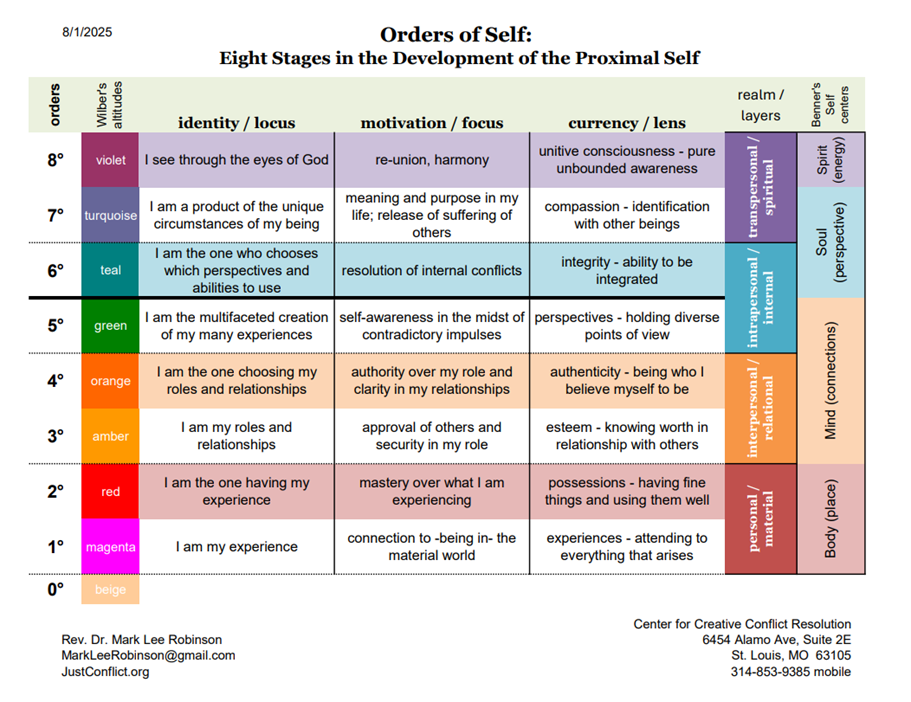
Back when I was in college, I discovered a fascination with how we form relationships with each other. I had no idea that I would choose to be a psychotherapist. I was working on a degree in chemistry. But in organic chemistry I noticed that that different molecules would form different bonds and that they seemed to have a sort of personality.
Since then, I have been creating my own map of how we relate to each other as persons who have a growing capacity to be conscious of our surroundings. That map has continued to grow and evolve. I have shared it as a graphic like this one, but I have only published an explanation of it in a book that didn’t get a wide readership.
In my writing now I have many times wished to reflect on current events from the point of view of this map, but I know how slim are the chances of my readers knowing what I was talking about when I suggest that some errant public policy was the product of Second Order thinking by people with no awareness of their own Fifth Order.
While most of my attention has been on individuals and their one-on-one relationships, it has also become clear that the pattern of the 8 Orders is present in all developmental sequences. And while we tend to think of such sequences as growth and progress, we can also see when growth is stunted and systems experience regression. That is largely what is happening in the world today.
To be able to use the map of the 8 Orders of Being we need a legend. We need that box in the bottom corner of the paper map that tells us that the blue lines are two-lane roads and that the circle with the star in it marks the capital city of the state. This is that legend..
This project features a series of videos and essays to enhance accessibility. The core material is organized into six sections, accompanied by related videos available via a YouTube playlist and this website.
- Part One: Cognitive Maps – Examines what cognitive maps are, provides examples, explains how they help us form perspectives, discusses their limitations, and distinguishes between simple, complicated, and complex maps as a means of understanding chaos.
- Part Two: Structure of Being – Explores the attempt to align thoughts with reality by observing truth claims, common features, distinctions, dimensions, development, and dialectics.
- Part Three: Graphic of the 8 Orders – Offers a visual walkthrough of the map, highlighting its components and relationships.
- Part Four: Developmental Hierarchies – Considers how growth occurs through stages, with a particular focus on normal human development to illustrate these hierarchies.
- Part Five: Evolution of Human Community – [This part will be addressed in a series of posts on Substack which you can find here.] Discusses how individuals and systems move through developmental stages, shaping cultures and governance through self-organization and emergence.
- Part Six: Transcendentals and Strange Loops – Addresses the forces and qualities that connect and transcend layers of reality, illustrating interconnectedness and mutual impact among the layers.
Here is a pdf of the text version of above listed Six Parts.