
A developmental hierarchy sees that certain qualities which arise along a given developmental line do so in a fixed sequence. This sequence happens for every instance of the same type. Each thing that develops does so by doing the steps in the same order. And no thing can develop without addressing and to a certain degree completing each of the steps. The steps in the hierarchy are universal, sequential, and essential. This is true for all developmental processes whether we are talking about the growth of a tree or the learning of mathematics.
One of the best-known early developmental hierarchies is Abraham Maslow’s Hierarchy of Needs. Maslow asserted that we could observe that the needs of humans are arrayed in a hierarchy and that the lowest needs must be sufficiently addressed before the higher order needs get our attention.
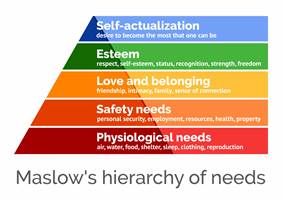
At the lowest order we have certain physical and relational needs. We need food, air, and water. We need warmth and sleep and freedom of movement. If we don’t have these basic needs, we will focus all our attention on getting them. These are the physiological needs.
When they are met, we are free to pursue the higher order needs of safety, and then love and belonging, then esteem, and finally self-actualization. Each level sets the stage for the next higher one. If those needs are not met, the lowest order needs are the ones we tend to place as the highest priority.
The opposite is also true. That is, when the lower order needs are met, attention to the higher order needs increases. Being satisfied puts upward pressure on the process of development. Creating social systems in which people’s lower order needs are met does not result in them being lethargic. Rather it increases their motivation for self-actualization.
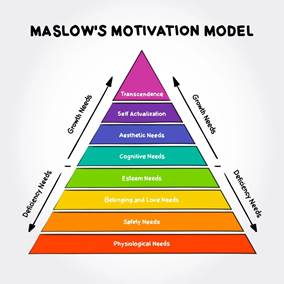
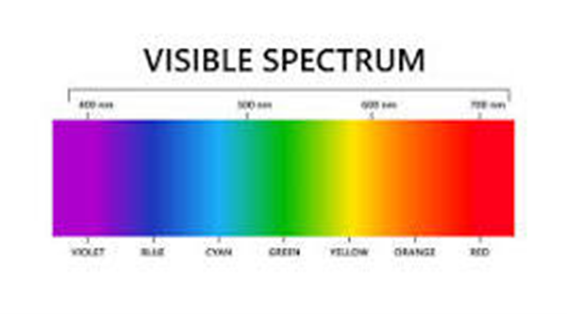
These dynamics are not solely the properties of Maslow’s Hierarchy of Needs. They are properties of all developmental sequences. This includes the 8 Orders. Early on Maslow only needed five levels for his purposes but later added three more to expand the meaning of Self-Actualization. But the number of levels is somewhat arbitrary. Like the spectrum of visible light there is no clear boundary between one color and another.
These are not eight separate things. They are eight distinguishable characteristics of the one thing that is our experience… of our lives.
We now turn to the 8 Orders.
The 8 Orders is a model for the structure of being itself. But we can’t see being. We can only observe how the structures of being impact objects and processes. Much as we can’t see an electro-magnetic field, we can’t see the structure of being. but when we toss iron fillings onto a glass plate and place a magnet below it, then we can observe the flux lines as the iron filings align themselves to it.

Most commonly the ‘iron filings’ I toss onto the glass plate to allow us to observe the 8 Orders is the experience of consciousness. Awareness is core to our knowledge of ourselves. But for this exploration I want to narrow the field even further. I want to look at how the properties of control and power arise and transform as we move through the 8 Orders.
Power and Control
For many years I worked in the field of domestic violence intervention. A common expression of the problem we were seeking to address was that certain men used power and control in relationships with their women partners. The term “power and control” was used to talk about a single thing, not two distinct properties. This was one of the things I found to be troublesome about how that community defined the problem we were addressing. For us here I want to make a distinction between power and control.
To be sure, they are closely related. But I want to show a way of understanding them by which they are inversely proportional. The less we try to be in control, the more powerful we become.
By control I mean the act of directing, regulating, or restraining behavior and outcomes. Control is about restriction.
By power I mean the capacity or ability to influence outcomes, shape events, or get things done. Power is about influence.
Control is a factor in the enactment of politics. Power is a factor in the deliberations of politics. You can have power without control (e.g., a respected elder who influences without rules) or control without true power (a bureaucrat who enforces policies but can’t inspire change).
- When I use my power to get something else to change, I am in control, I have power over.
- When I join with someone else to create what we both want, I am using power with.
- When I am getting myself to change such that I am creating more of what I need, I am empowered.
The distinction between power and control is subtle but crucial.
Power and control at each of the steps/stages
Remember that we are looking at a spectrum here and that the steps or stages are simply ways we have of holding distinctions in our awareness. They are not experienced as distinct except for one important phenomenon. When we are looking at any given experience, situation, or problem we focus on it from a particular locus and seeing it through a particular lens. Remember the focus, the locus and the lens. There are things that arise for us that can be best seen from a particular perspective, that is using the best possible lens.
There are things that we simply don’t see until we are able to rise to a particular stage of our development. When we can focus on them, we can understand them and relate to them better if we use a complex enough lens. And when we do so we feel as though we are looking from a new perspective.
We are going to climb through the 8 Orders to see how the properties of control and power shift as we do so.
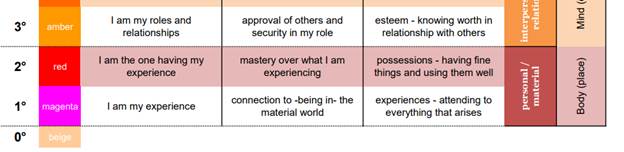
First Order is the realm of whatever is arising in the moment. It is the home of “it is what it is.” We can be confident that reality is arising whether we are conscious of it or not. And we know that far more is real than we can possibly know. Neither power nor control are in evidence at First Order.
Second Order is where the perceived chaos of First Order begins to have shape. We have the power to give things names and to understand how to act to change our experience. We can control whether we are hot or cold, hungry or fed, tired or rested. At Second Order there is very little that distinguishes control from power. All of what we do, which is an expression of control, arises at Second Order. And much of what we do to gain control is a reaction to our fear of being powerless.
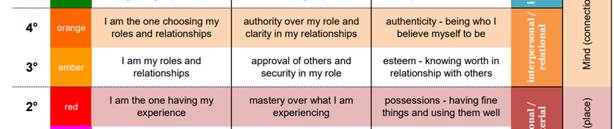
Third Order introduces to us the collective power of the larger community. We discover that our ability to use language to shape our experience comes from the long history of those who have gone before. We are ourselves shaped by culture and government. Our wish to drive fast is constrained by legal consequences. But when we comply with the law we can appeal to the courts and use that power for our own benefit.
Fourth Order arises for us as we chaff at the social forces we experience that seem to limit our capacity to be most truly ourselves. Deciding who we are and how we will show up in our lives is to a significant degree a reaction to the controls of others. We want the power to be ourselves with authenticity and integrity. We will be the captain of our destiny.
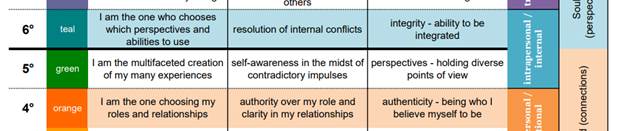
Fifth Order catches us up short. We can only escape it by a denial of our own interiority. We discover that we are not only not in control of others, but we are also not even in control of ourselves. We are not who we claim to be. There are parts of us which act to thwart other parts of us. It is as though there are multiple aspects of our will which conflict with each other. Some parts try to control other parts. But in the awareness of these conflicts and of the parts themselves we discover that our simple awareness can soften the tension. Simply paying attention to us is itself a source of power.
Sixth Order feels like dawn after the dark night. Profound tensions reveal themselves to simply be the natural order of things. That the fabric of being is paradoxical is just as it must be. Those tensions are not flaws, but the edges by which the contours of reality are formed. We can see clearly that the only control we have ever had was the power to choose how we would show up in the world. Any effort we make to change others, whether people or systems, was futile. We have power in the world by creating what we need such that others have it as well.
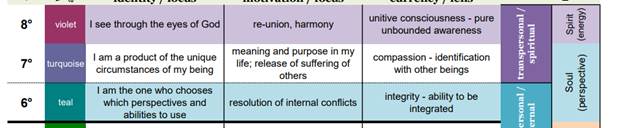
Seventh Order may be evidenced to us by a deep listening to our interior. It may come to us as intuition or as voices of spirit guides or angels or a variety of spiritual beings. We can align ourselves with the guidance that such influences can offer us. We can discern wisdom and folly, and our only control is to soften into alignment with the unique purpose of our being.
Eighth Order is the realization that everything is connected to everything everywhere all the time. There is nothing to control. Everything is just as it must be. And there is no self except the totality of the universe.
States and Stages
As we consider states of being and stages of development it is important that we recognize that they are very similar but also distinct. A state may be characterized by qualities of a given order and a stage of development may have similar qualities, but it is useful to see them as different.
For example, I may have a fleeting sense of the source of my anxiety and thus a window into my own interior at Fifth Order, but I can only get there when in a session with my therapist. I can experience that state but am not yet at that stage.
Similarly, I may have a very stable sense of the father that I am and want to be and that this is a durable Fourth Order stage that I have created which distinguishes me from my own father. But when my son lies to me, I may have a flash of Second Order rage and want to smack him. My state at that moment is less mature than my stage.
Transcend and Include
Moving to a more mature stage involves transformation. We become able to use cognitive maps that take into account more of the complexity of reality and thus we can make choices that do a better job of creating what we need. Moving to higher orders thus opens up for us possibilities we didn’t see before. We transcend the old way of being so as to arise to a new way of being. This new way is only possible by building on the prior structures. None of this is possible without a deep grounding in all the prior orders. They stand on each other’s shoulders. Almost nothing is lost as we embrace the reality of all 8 Orders. But there are things we must let go of.
To move from Second to Third we must give up our freedom to do whatever we want. We must align with the greater good and the existing structures of culture and community.
To move from Third to Fourth we must let go of being who we think others want us to be and the security of pleasing them and allow ourselves to find our unique path and purpose.
To move from Fourth to Fifth we must lose our idealization of ourselves and see our own messiness.
To move from Fifth to Sixth we must calm our anxiety about paradox. We must allow two apparently opposite things to exist equally.
To move from Sixth to Seventh we need to abandon our need to know how we know and just allow ourselves to discern from a place of clear intuition.
To move from Seventh to Eighth we must let go of any notion that we are separate.
And after Eight? What comes after Eight?
Dr. Mark Lee Robinson
August 20, 2025